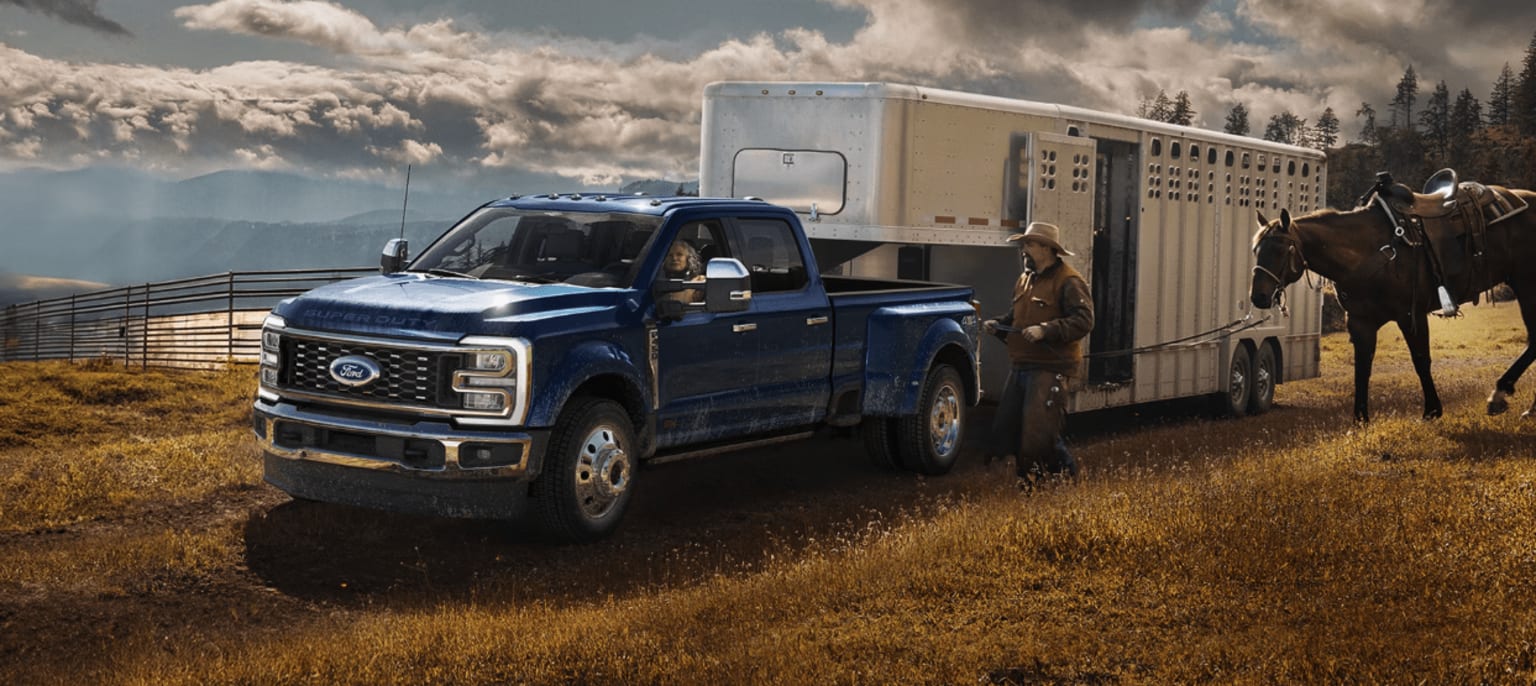
Ford F250 Towing Capacity: Complete Guide & Specs
Are you searching for a heavy-duty truck that can handle big hauling jobs? It’s key to know your vehicle’s towing power. This is important for job sites, large recreational vehicles, or equipment transport in Washington state.
The 2025 Super Duty offers top-notch performance with three engine options. The 6.8L V8 has 17,300 lbs, and the 7.3L V8 goes up to 19,500 lbs with fifth-wheel setups. The 6.7L turbo diesel engines can tow an amazing 22,300 lbs for heavy-duty hauling. Each engine comes with a TorqShift-G ten-speed automatic transmission for smooth, reliable driving. The 2024 Ford Super Duty lineup includes a range of models like the F-250, F-350, and F-450, each offering multiple engine options and configurations to suit different heavy-duty needs.
At Way Scarff Ford in Auburn, WA, we’re all about helping you find the right truck. Our extensive inventory of Ford Super Duty trucks ensures you have access to a wide variety of models and configurations. Our team at 501 Auburn Way North knows how important super duty specs are, and we can help you compare the Ford Super Duty and Ford Super Duty F models to find the best fit. Whether you’re moving boats to Puget Sound or handling construction, we’ll help you understand every detail of the ford f250 towing capacity. Call us at 253-833-1500 to find out which setup fits your lifestyle. In this article, we’ll cover the key features of the F-250 and its impressive towing capabilities.
Introduction to Ford F250 Towing
The Ford F250 stands out as a heavy duty truck built for those who demand exceptional towing capabilities. Whether you’re hauling a large boat to the lake, towing a travel trailer across the country, or moving heavy equipment for work, the F250 is engineered to handle the toughest jobs. With a range of powerful engine options—including the renowned 6.7L Power Stroke V8 Turbo Diesel—the F250 delivers a maximum towing capacity of up to 22,000 pounds when properly equipped. This means you can confidently tackle even the most challenging towing tasks, knowing your truck is up to the job.
The F250’s robust frame, advanced towing features, and brawny power make it a top choice for anyone who needs to move heavy loads. The available 6.7L Power Stroke V8 turbo diesel engine is especially popular for its impressive torque and reliability, ensuring you have the muscle needed for demanding towing conditions. No matter which engine configuration you choose, the F250 is designed to provide maximum performance and durability, making it a trusted partner for both work and recreation. If you’re looking for a truck that can handle your towing needs with ease, the Ford F250 is ready to deliver.
Ford F250 Towing Capacity: What You Need to Know
Before you hitch up that trailer or load up for a big job, we want to help you understand the F-250’s towing capabilities inside and out. Knowing your f 250 towing capacity is crucial for safely handling maximum trailer weight and payload, as these numbers can vary significantly based on your truck’s specific configuration. The numbers you see advertised tell only part of the story. Your specific truck’s capacity depends on several factors working together, from engine choice to cab style to drivetrain configuration.
We know that selecting the right F-250 means matching your truck’s specs to your real-world hauling needs. In many f 250 towing scenarios, this truck excels in heavy-duty applications, making it a top choice for demanding jobs. That’s why we’ve broken down everything you need to know about towing ratings, weight limits, and configuration choices. Let’s dive into the details that matter most when you’re ready to put your F-250 to work.
In the following sections, we’ll break down the F-250’s performance specs in detail to help you make the best decision for your needs.
Maximum Towing Ratings for Current F250 Models
The 2025 F-250 lineup delivers impressive pulling power across all engine options. Your f250 max tow rating varies based on which powertrain you choose and how your truck is configured. With conventional towing setups, the base 6.8L V8 engine can pull up to 17,300 pounds when properly equipped. In addition to towing, it's important to consider the payload specs for each engine and configuration, as these determine how much weight your truck can carry in the bed.
Stepping up to the diesel powertrains significantly increases your capabilities. The 6.7L Power Stroke diesel engines push the maximum conventional towing capacity to an impressive 22,000 pounds. This makes the F-250 one of the strongest contenders in the heavy-duty pickup segment.
Here’s how the towing numbers break down across different configurations:
Engine Option | Conventional Towing | Fifth-Wheel/Gooseneck | Payload Capacity |
|---|---|---|---|
6.8L V8 Gas | 17,300 lbs | 17,300 lbs | 3,960 lbs |
7.3L V8 Gas | 20,000 lbs | 19,500 lbs | 4,246 lbs |
6.7L Power Stroke Diesel | 22,000 lbs | 22,300 lbs | 4,090 lbs |
6.7L High-Output Diesel | 22,000 lbs | 22,300 lbs | 3,918 lbs |
These ratings represent maximum capacities with optimal configurations. Your actual towing ability depends on how you spec your truck and what equipment you add. The Super Duty F lineup, including the F-250, F-350, and F-450, offers a wide range of heavy-duty capabilities, so choosing the right combination ensures you get the performance you need for your specific applications.
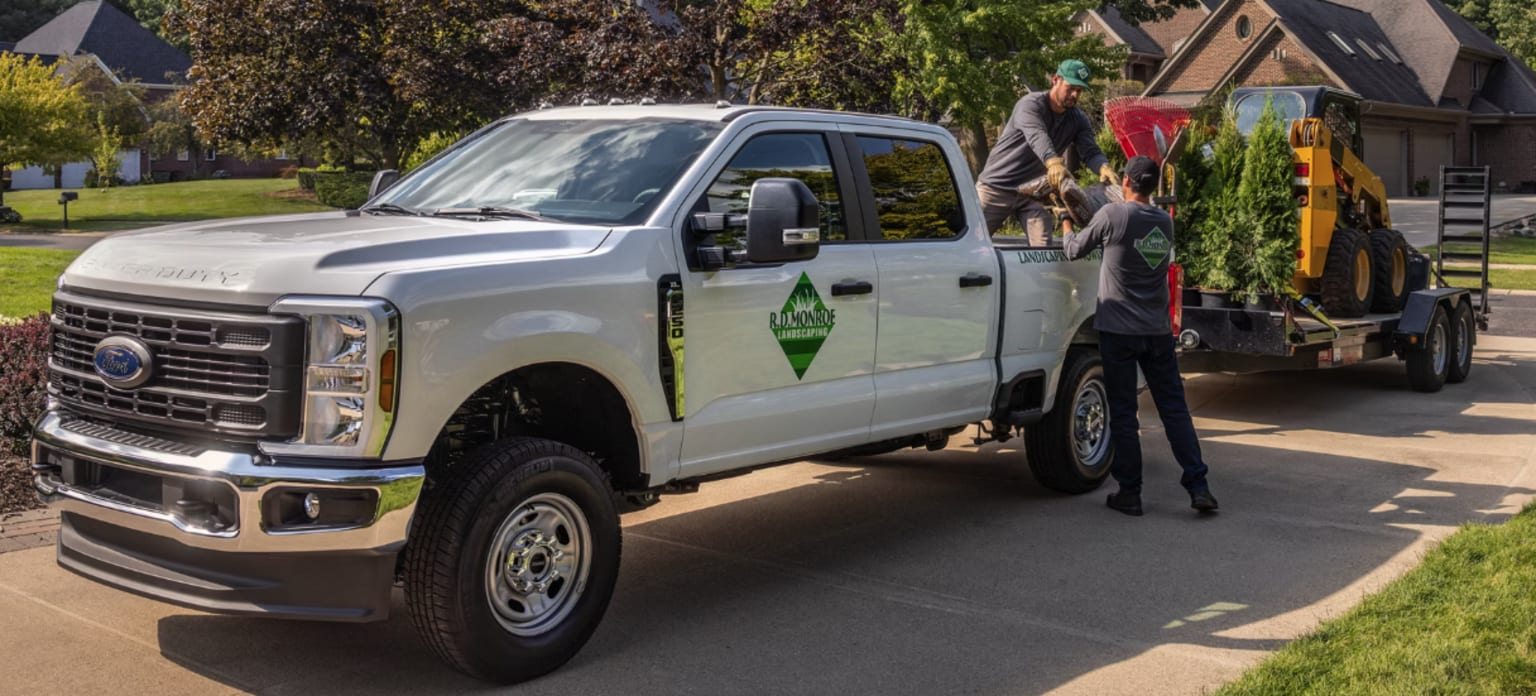
Gooseneck and Fifth-Wheel Towing Capabilities
When you need to haul heavy trailers like horse rigs, large RVs, or construction equipment, f250 gooseneck towing offers superior stability and control. These mounting systems position the hitch in the truck bed directly over the rear axle. This placement distributes weight more effectively than traditional bumper-pull setups. Choosing the right trailer combination is essential, as it can further enhance stability and safety by working with the F-250’s vehicle safety systems to monitor and control trailer sway.
Both gooseneck and fifth-wheel configurations allow you to tow significantly heavier loads. The weight distribution also improves handling and reduces the stress on your truck’s frame. Many commercial operators and serious recreational towers prefer these setups for exactly these reasons.
Fifth-Wheel Towing Configuration
Fifth-wheel hitches mount in your truck bed and connect to a kingpin on the trailer. This setup works exceptionally well for large RVs and travel trailers. For those seeking luxury and capability in a fifth-wheel towing setup, the King Ranch trim is available as an option. The 6.8L V8 can handle up to 17,300 pounds with a fifth-wheel configuration.
The 7.3L V8 increases your fifth-wheel capacity to 19,500 pounds. For maximum hauling capability, both 6.7L Power Stroke diesel options can pull up to 22,300 pounds. This makes them ideal choices when you’re moving substantial loads regularly.
Gooseneck Hitch Maximum Ratings
Gooseneck hitches use a ball mount in the truck bed and offer the same impressive capacity ratings as fifth-wheel setups. The positioning over the rear axle provides excellent stability during turns and on uneven terrain. This configuration is popular with farmers, ranchers, and commercial haulers.
The gooseneck maximum ratings match the fifth-wheel numbers because both systems utilize the same weight distribution principle. You'll achieve the same 22,300-pound capacity with diesel engines in either configuration. The choice between them often comes down to what type of trailer you're pulling and personal preference.
Understanding GCWR and Payload Limits
Two critical terms affect how much you can safely tow: GCWR and GVWR. The f250 gcwr, or Gross Combined Weight Rating, represents the total allowable weight of your loaded truck plus your loaded trailer combined. This is the maximum total weight you’re allowed to have rolling down the highway.
GVWR stands for Gross Vehicle Weight Rating. This number represents the maximum your truck can weigh when fully loaded, including passengers, cargo, and tongue weight. The GVWR is the maximum allowable weight of the fully loaded vehicle, and exceeding this limit can compromise safety and damage the vehicle. Staying within these limits isn’t just about performance—it’s about safety and legal compliance.
Here’s where many truck owners get surprised: your trailer’s tongue weight counts against your payload capacity, not your towing capacity. For proper weight distribution, tongue weight should typically be 10-15% of your trailer’s total weight. If you’re towing a 10,000-pound trailer, that means 1,000 to 1,500 pounds pressing down on your hitch.
The ford truck payload capacity ranges from 3,918 pounds to 4,246 pounds depending on your engine choice. If you’ve got that 1,500-pound tongue weight plus tools, equipment, and passengers in your truck, you need to ensure the combined weight doesn’t exceed your specific payload rating. This calculation is essential for safe towing operations.
Cab Configuration and Bed Length Impact on Capacity
Your choice of cab style directly affects your F-250’s maximum towing numbers. Regular Cab models typically offer the highest towing capacity because they’re the lightest configuration. SuperCab models add rear-hinged doors and more interior space but include additional weight that slightly reduces capacity. The F-250 is available in a variety of bed configurations, allowing you to choose the bed size that best fits your cargo and towing needs.
Crew Cab configurations provide the most passenger room with four full-size doors. They’re also the heaviest cab option, which can lower your maximum towing ratings compared to Regular Cab models. Crew Cab models enhance passenger comfort with increased interior space, making them ideal for those who prioritize seating and ride quality. The difference might only be a few hundred pounds, but it matters when you’re pushing capacity limits.
Bed length affects your truck’s wheelbase and overall weight distribution. A longer bed generally provides better stability when towing heavy loads behind you. The extended wheelbase reduces sway and improves control, making it ideal for fifth-wheel and gooseneck trailers.
Drivetrain choice makes a real difference too. The 4x2 (two-wheel drive) models can usually tow more than 4x4 (four-wheel drive) versions. The four-wheel-drive system adds several hundred pounds to your truck’s curb weight. While 4x4 provides benefits for off-road capability and winter traction, it does reduce your maximum towing capacity slightly.
Axle ratio selection is another key consideration for maximizing your towing performance. Higher numerical ratios like 4.30:1 provide more pulling power compared to lower ratios like 3.73:1. The trade-off is that higher ratios may slightly reduce fuel economy when you’re not towing. If you regularly pull heavy loads, opting for the higher axle ratio makes sense.
Towing packages offered by Ford include features like upgraded cooling systems, trailer brake controllers, and integrated trailer backup assist. These packages optimize your truck for heavy hauling and make towing safer and easier. They’re essential if you plan to regularly operate near your truck’s maximum capacity.
If you have questions about which F-250 configuration is right for your towing needs, we invite you to visit us at Way Scarff Ford. Our dealership is located at 501 Auburn Way North in Auburn, WA 98002. You can also give our knowledgeable team a call at 253-833-1500, and we’ll help you find the perfect F-250 setup for your hauling requirements.
How Engine Choice Affects Your F250 Towing Performance
Choosing the right engine for your F-250 is key. The engine under the hood affects towing, fuel costs, and driving. For those who need maximum towing capacity and torque, diesel power stands out as the top choice, offering superior performance for heavy-duty tasks compared to gasoline engines. We aim to help you pick the best engine for your needs.
The 2025 F-250 has three engine families for different towing needs. From the 6.8L V8 gas to the 6.7L Power Stroke diesel, each engine has its strengths. Let’s explore what each offers.
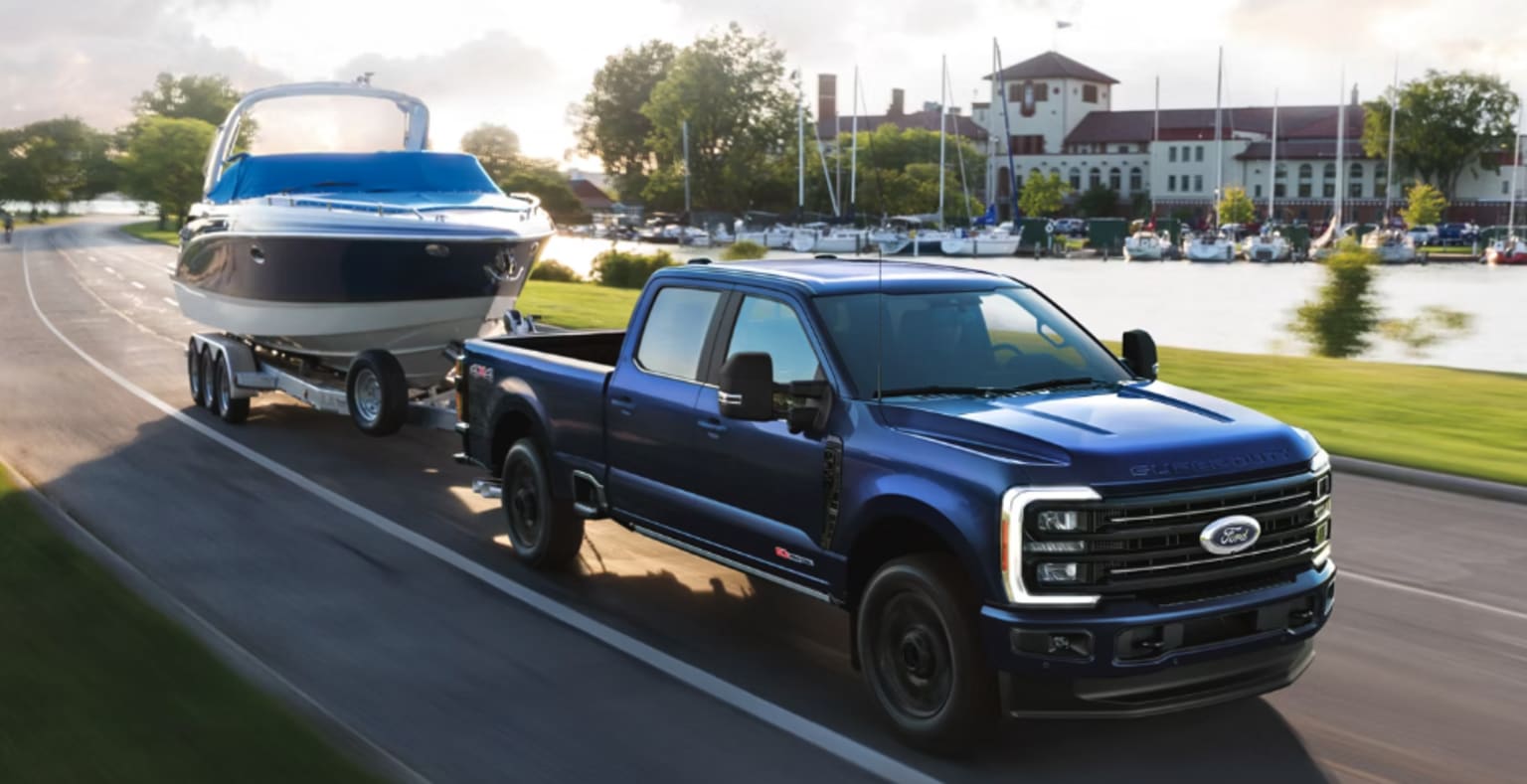
6.8L V8 Gas Engine Specifications
The 6.8L V8 is the base engine for XL, XLT, and Lariat trims. It has 405 horsepower and 445 pound-feet of torque. It comes with Ford's TorqShift-G ten-speed automatic transmission for smooth power.
You can get the 6.8L with 4x2 or 4x4 drivetrain. It's reliable for everyday truck tasks. It's also cheaper than diesel options at first.
Towing Capacity and Torque Ratings
The 6.8L V8 can tow up to 17,300 pounds. This meets most trailer weight limits for fun and work. It can carry up to 4,240 pounds.
The 445 lb-ft torque is enough for most towing. It accelerates well with moderate loads. It handles towing in the 10,000-15,000 pound range well.
Best Use Cases for the 6.2L
The 6.8L is best for occasional towing. It's great for weekend trips, boat owners, and contractors. It's perfect for loads under 15,000 pounds.
It's simpler to maintain than diesel engines. No DEF fluid is needed. Gas engines cost less to service over time.
This engine is good for Auburn-area truck owners who want power without diesel hassle. It's a great choice for farms, small businesses, and fun towing.
7.3L V8 Gas Engine Heavy-Duty Power
The 7.3L V8, known as "Godzilla," offers more power. It has 430 horsepower and 485 pound-feet of torque. It's available on all trim levels.
Ford pairs the 7.3L with 4x4 drivetrain. It's perfect for those needing strong towing and traction. It's the best gas engine for heavy-duty towing.
Maximum Towing with the 7.3L
The 7.3L can tow up to 18,200 pounds conventionally. Fifth-wheel and gooseneck towing reach 19,500 pounds. That's 2,000 pounds more than the 6.8L.
It has the highest payload rating at 4,246 pounds. It's powerful for climbing and passing. The extra torque is noticeable at maximum capacity.
Fuel Economy vs. Performance Trade-offs
The 7.3L uses more fuel than the 6.8L, but it's worth it for heavy towing. It's more expensive at the pump but offers better performance. It's great for merging and mountain passes.
It's a good choice for towing over 15,000 pounds. It's cheaper than diesel upfront. You avoid DEF fluid and diesel maintenance, but it's worth it for the power.
6.7L Power Stroke Diesel: The Towing Champion
The 6.7L Power Stroke diesel is the top choice for towing in the F-250 lineup. It has 475 horsepower and 1,050 pound-feet of torque. There's also a high-output version with 500 horsepower and 1,200 pound-feet of torque. Both are available on all trim levels.
These diesel engines are the best for heavy towing. You can choose 4x2 or 4x4 drivetrain. They offer more power than gas engines, but cost more upfront.
Peak Torque and Towing Advantages
The diesel engines have massive torque, making them perfect for heavy loads. They have more torque at lower RPMs, making towing easy. They can tow up to 22,000 pounds conventionally and 22,300 pounds with fifth-wheel or gooseneck setups.
They offer better control on steep grades and engine braking on descents. The transmission works less hard during towing. They have strong pulling power across a wide RPM range thanks to modern turbocharging.
Why Diesel Excels for Heavy Loads
Diesel fuel is more energy-dense than gasoline, improving efficiency when towing. Diesel engines extract more work from each gallon of fuel. This means better fuel economy when towing heavy loads compared to gas engines.
The 6.7L Power Stroke delivers power when you need it most. It's effortless to pass even with maximum loads. It's perfect for mountainous terrain.
If you tow over 15,000 pounds regularly, diesel is a good choice. It's more expensive upfront but offers better efficiency and capability. It's best for commercial users and full-time RV travelers. The engine requires DEF fluid and more expensive maintenance, but it's worth it for serious towing.
Engine Option | Horsepower | Torque (lb-ft) | Max Conventional Towing | Max Fifth-Wheel Towing | Max Payload |
|---|---|---|---|---|---|
6.8L V8 Gas | 405 HP | 445 lb-ft | 17,300 lbs | 17,300 lbs | 4,240 lbs |
7.3L V8 Gas | 430 HP | 485 lb-ft | 18,200 lbs | 19,500 lbs | 4,246 lbs |
6.7L Power Stroke Diesel | 475 HP | 1,050 lb-ft | 22,000 lbs | 22,300 lbs | 4,200 lbs |
6.7L High-Output Diesel | 500 HP | 1,200 lb-ft | 22,000 lbs | 22,300 lbs | 4,200 lbs |
Every engine comes with Ford's advanced TorqShift-G ten-speed automatic transmission. This transmission has SelectShift technology for manual gear selection. It's useful for engine braking on descents or holding specific gears while towing.
Choosing the right engine is important for your truck's performance, costs, and satisfaction. Our team at Way Scarff Ford can help you find the perfect F-250 for your needs. Visit us at 501 Auburn Way North in Auburn, WA 98002, or call 253-833-1500 to discuss your options.
Travel Trailer Towing
Towing a travel trailer is one of the most popular uses for the Ford F250, and it’s easy to see why. With its maximum towing capacity of up to 22,000 pounds, the F250 is more than capable of handling even the largest travel trailers on the market. Advanced features like Pro Trailer Backup Assist take the stress out of maneuvering your trailer, allowing you to reverse with confidence and precision. The integrated trailer brake controller and trailer sway control systems work together to keep your trailer stable and secure, even in challenging driving conditions.
Whether you’re planning a cross-country adventure or a weekend getaway, the F250’s exceptional towing capabilities ensure you can bring along all the comforts of home. The Pro Trailer Backup system makes it simple for both seasoned RVers and first-time trailer owners to navigate tight campsites and tricky parking spots. With the Ford F250, you can focus on enjoying the journey, knowing your travel trailer is in good hands.
Towing Safety Tips
Safety is always a top priority when towing, and the Ford F250 is equipped with advanced features to help you tow with confidence. Pro Trailer Hitch Assist and the available pro trailer hitch make connecting your trailer quick and accurate, reducing the risk of misalignment. Trailer sway control actively monitors your trailer’s movement and applies corrective braking if sway is detected, helping to keep your trailer steady on the road.
To further enhance your towing experience, always remember to properly secure your trailer before setting out. Double-check that all connections are tight, safety chains are in place, and your load is evenly distributed. Regularly inspect your tire pressure on both the truck and trailer, as underinflated tires can affect handling and safety. Avoid sudden steering or braking maneuvers, and allow extra stopping distance when towing heavy loads. By combining these best practices with the F250’s built-in safety technologies, you can enjoy a smooth and secure towing experience every time.
Test Drive and Purchase Considerations
When you’re ready to invest in a new truck with exceptional towing capabilities, the Ford F250 should be at the top of your list. Before making your decision, take the time to schedule a test drive and experience the F250’s performance firsthand. Pay close attention to how the truck handles under load, the responsiveness of the ten speed automatic transmission, and the comfort of the front seats during longer drives.
Consider important factors like towing capacity, gross vehicle weight rating, and maximum payload capacity to ensure the F250 meets your specific hauling needs. Explore the available engine options, including the powerful turbo diesel engine, and think about which configuration best matches your towing demands. Don’t forget to review standard features and available towing technologies that can make your towing experience safer and more convenient.
By doing your research, consulting with knowledgeable staff at your local Ford dealership, and taking the F250 for a thorough test drive, you’ll be well-equipped to choose the perfect new truck for your heavy loads and towing adventures. The right F250 will provide years of reliable service, whether you’re on the job site or heading out for a weekend escape.
Conclusion
The Ford F-250 offers great versatility. It can tow from 17,300 to 22,300 pounds. The exact capacity depends on the engine, cab style, bed length, and equipment.
Choosing the right setup is key, not just for the highest numbers. Payload limits, tongue weight, and real-world use are all important for safe towing. The F-250 has options for all kinds of hauling, from work to fun.
At Way Scarff Ford, we're here to find the perfect F-250 for you. Our team will explain how different setups affect towing capacity. We'll help you understand engines, axle ratios, and towing packages.
Visit us at 501 Auburn Way North in Auburn, WA 98002, or call 253-833-1500. Our experienced staff will guide you through the selection process and arrange test drives. We offer ongoing service support to keep your Super Duty running well for years. Let us help you find the truck that meets your hauling needs.
FAQ
What is the maximum towing capacity of the 2025 Ford F-250?
The 2025 Ford F-250 can tow up to 22,300 pounds. This is when it has the 6.7L Power Stroke diesel engine and a gooseneck or fifth-wheel setup. With conventional towing, it can tow up to 22,000 pounds with diesel engines. At Way Scarff Ford in Auburn, WA, we can help you find the right setup for your needs.
How much can a Ford F-250 diesel tow compared to gas engines?
The Ford diesel can tow up to 22,000-22,300 pounds. This is more than the 6.8L V8 gas engine, which can tow up to 17,300 pounds. The 7.3L V8 can tow up to 19,500 pounds with a fifth-wheel setup. The diesel's torque is much higher, making it better for heavy towing. Visit Way Scarff Ford at 501 Auburn Way North in Auburn, WA 98002 to discuss your towing needs.
What is the difference between GCWR and towing capacity on the F-250?
GCWR is the total weight of your truck and trailer. Towing capacity is how much trailer weight your truck can pull. The F-250's GCWR is always higher than its towing capacity. It's important to not exceed the GCWR for safe towing. Our team at Way Scarff Ford can help you understand these ratings.
How much weight can an F-250 carry in the bed (payload capacity)?
The 2025 F-250's payload capacity ranges from 3,918 to 4,246 pounds. The 7.3L V8 offers the highest payload at 4,246 pounds. Remember, your trailer's tongue weight counts against this capacity, not your towing capacity. This is important for safe operation.
What are the f250 trailer weight limits for conventional versus gooseneck towing?
Conventional towing limits for the F-250 range from 17,300 pounds with the 6.8L V8 to 22,000 pounds with diesel engines. Gooseneck and fifth-wheel setups can tow up to 22,300 pounds. These setups provide better stability and control for heavy loads.
Does cab configuration affect how much my F-250 can tow?
Yes, cab configuration impacts towing capacity. Regular Cab models offer the highest towing capacity. SuperCab and Crew Cab models have lower capacities. Bed length and 4x2 models also affect towing capacity. Visit Way Scarff Ford to find the right configuration for you.
What engine should I choose for towing a fifth-wheel RV that weighs 18,000 pounds?
For towing an 18,000-pound fifth-wheel RV, choose the 6.7L Power Stroke diesel engine. The 7.3L V8 can also tow up to 19,500 pounds, but the diesel's torque makes towing easier. Call Way Scarff Ford at 253-833-1500 to discuss your RV towing needs.
How does axle ratio affect towing capacity on the Ford F-250?
Axle ratio impacts towing performance. Higher ratios like 4.30:1 provide more pulling power. This is beneficial for heavy loads and hilly terrain. Higher ratios may reduce fuel economy when unloaded. Our team at Way Scarff Ford can help choose the right axle ratio for you.
What is tongue weight and why does it matter for F-250 towing?
Tongue weight is the force your trailer puts on your truck's hitch. It's 10-15% of your trailer's total weight. This affects your truck's payload capacity, not towing capacity. Exceeding your payload rating can be unsafe. Proper tongue weight ensures stable towing.
Can I tow more with a Ford F-250 than with an F-150?
Yes, the Ford F-250 can tow more than the F-150. The F-250 can tow up to 22,300 pounds, while the F-150 maxes out at 14,000 pounds. The F-250 also has higher payload capacity and stronger construction. It's better for heavy towing.
What towing features and technology does the 2025 F-250 offer?
The 2025 Ford F-250 has advanced towing technology. It includes Pro Trailer Backup Assist, Trailer Reverse Guidance, and an integrated trailer brake controller. These features make towing safer and easier. Visit Way Scarff Ford to learn more.
Do I need a special driver's license to tow with an F-250 in Washington state?
For personal towing, you don't need a special license in Washington state. A standard driver's license is enough. But for commercial towing, you might need a Class A CDL. Check with the Washington State Department of Licensing for details. Our team at Way Scarff Ford can answer other questions about your F-250.
How often should I service my F-250 if I tow frequently?
If you tow frequently, follow Ford's severe duty maintenance schedule. This means oil changes every 5,000 miles or less, and more frequent transmission fluid changes. Regular brake inspections and tire rotations are also important. Heavy towing stresses your truck, so regular maintenance is key. Visit Way Scarff Ford's service department for a tailored maintenance schedule.
What's the difference between the standard and high-output 6.7L Power Stroke diesel?
Both versions of the 6.7L Power Stroke diesel offer great towing. The high-output version has 500 horsepower and 1,200 pound-feet of torque. This makes it better for heavy towing. If you need the best towing performance, choose the high-output diesel. Both options are available at Way Scarff Ford.
Can the Ford F-250 tow in steep mountain terrain safely?
Yes, the Ford F-250 is great for mountain towing. The 6.7L Power Stroke diesel engines provide strong torque for steep grades. The TorqShift-G ten-speed transmission and SelectShift feature help control speed. With the right equipment and driving, your F-250 can handle mountain towing safely.